Category Archives: A-Level

143. Jumping the gap

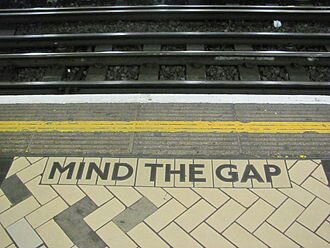
The transition from GCSE to A-level Maths is as smooth as can be for some students. Others need the London Underground sign:
image

This time last year the biggest issue (amongst many others) was the lack of logic and rigour in their algebraic solutions and graphs. I tried giving model answers (‘Thank you, Miss’, then file it in the recycling …. Grrr!). I tried explaining why it was important (you could almost hear the shutters slide down in most of their heads). I tried sharing the best student’s work on the board using the visualiser (type of document camera), but all to no avail. The majority of students thought they knew best and ignored all advice.

image

Now rather than go all Professor Umbridge on them*, I switched things around. They critiqued each other’s work.

Activity

1. You will need an exam (style) question, paper and post-it notes.

2. Ask students to complete the question on a sheet of paper – do not write names on it.

3. Put all the solutions out at the front or stick them to the board.

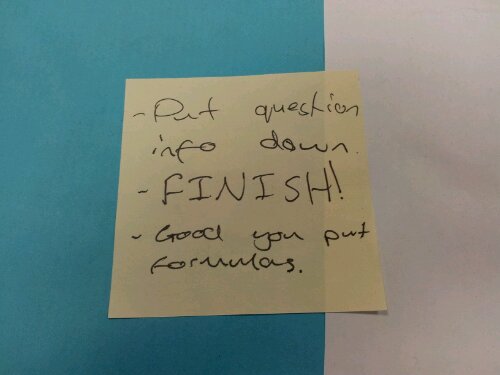
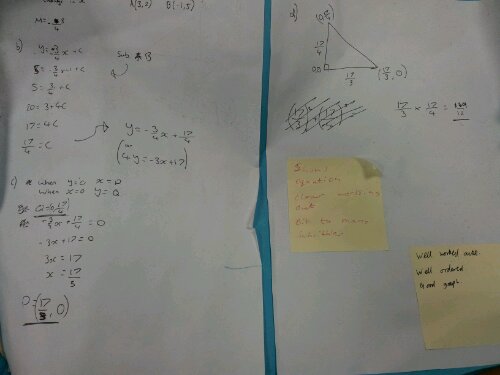
4. Give each student three post-its. They should write something good and something to improve and stick it on the work. Do this three times.
image

5. Each student reclaims their work and reads the notes. They then discuss the feedback and draw up a list of keypoints for improvement.
image

That could be the end of it, but I wanted to remind them of the task so:

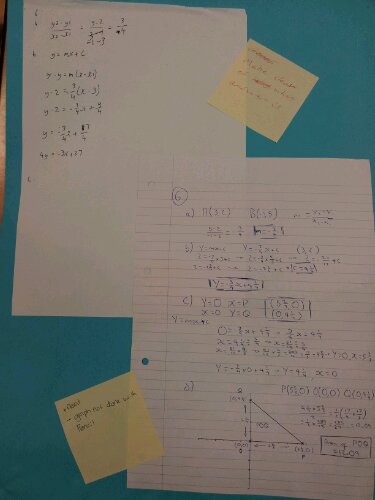
6. Collect in the work and notes and mount them on half a noticeboard.
image

7. In the middle of the board put the question, the model solution and their list of key points for improvement.

8. For the next week or so keep referring to the wall display in lesson.

9. Set another question and repeat steps 2-5. Discuss how their work has (hopefully) improved.

10. Fill the remainder of the wall display with the work and comments.

This could be a useful activity to do at the start and end of a topic. It would also be a good BLP (Building Learning Power) activity.

* Professor Umbridge had a particularly sadistic detention task in Harry Potter, where whatever you wrote on the paper was etched into the detainee’s skin. Vile woman, odd ideas on education.

125. View from … Pensthorpe

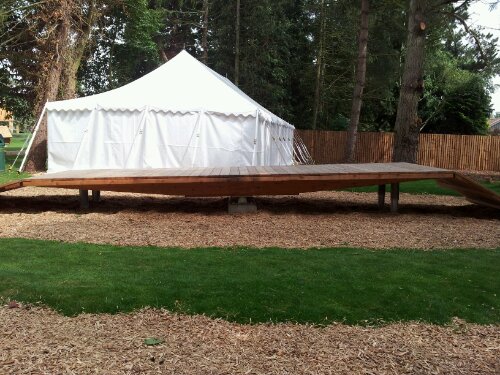
The Sandpit is currently in Norfolk and on a daytrip to Pensthorpe. In the ‘Wild Rootz’ adventure playground there is a bridge – except it’s not.

image

It’s a damped ‘see-saw’, which you can run up and down. This is great fun – people run from one end to the other and try to reach the end before it goes down, with a bump.

image

However, you can also use the principle of moments to try and balance the bridge. It took a bit of running up and down and fine tuning (bouncing), but we got the bridge balanced with five members of the family, age range: 84, weight range: wouldn’t be polite to say.

If you know somewhere near you, with a similar piece of equipment, this would be a brilliant way to demonstrate moments with a Sixth Form class. Obviously the calculations would be slightly out, due to the effect of the dampers, but it’s still fun – and a lot safer than piling a whole class on a see-saw.

68. Another GCSE revision idea

You will be surprised to hear that this activity doesn’t involve cutting up a GCSE paper! See Foundation GCSE student review and How to make GCSE past papers fun.

Equipment
Digital version of a GCSE (or A-Level or Functional Skills) paper
Individual whiteboards & pens
Digital projector

Set up
Split the class into groups of 4-6. They will need a whiteboard each. Allocate a team number/letter or name. Project the first question on the screen.

Activity
Use the GCSE paper to set (part of) a question for the class.
They all answer on their whiteboards and hold up the answer when you say.

The beauty of this method is you can adapt the questions to the understanding of the class and focus on specific skills, as opposed to issuing a paper version and going through every question.

Scoring
It’s quite common for a few bright/strong characters to take over team games, unless you can find a way to avoid this. The scoring is quite easy.

2 points if every member of the group gets the answer right.

1 point for each team, if more than one team is 100% correct.

You may think that this will encourage copying, but there is a third score:

-1 point if you can’t explain your answer

This means teams must work together to ensure everyone understands the solution. After all, these are exam questions which may take several minutes to complete. There is little value in using this as a revision tool if pupils don’t progress – which is where the peer explanation comes in.

Review
My class really enjoyed doing this on Friday as preparation for their end of year eams. It allowed me to pick out the most appropriate revision questions, without running up the photocopying bill!

58. Free Revision App

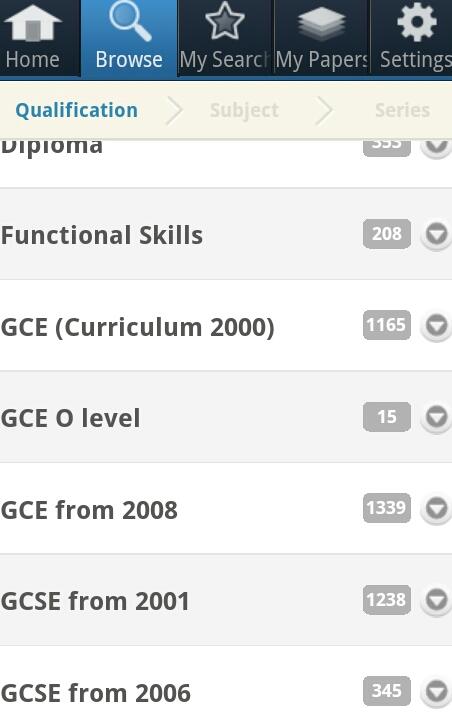
I’ve recently started using the Edexcel Past Papers revision app (Apple & Android compatible) with my GCSE and A-Level classes.
image

It is basically a database of past papers for all Edexcel subjects and qualifications, even iGCSE. You search by qualification, then subject, then exam session, then paper. The papers and mark schemes are already available on the internet, but the app is much quicker than googling them. It is not a complete revision resource, but it is fairly comprehensive app. Some of the PDFs are e-versions, some are scans. You can also share papers by email, which allows you to print.

The recent material is still only available through the secure teacher area of the Edexcel website, so your mock exams won’t be compromised.

My Y11 have downloaded it for personal use when they are on study leave. They suggested that even though they don’t use Edexcel for every subject, they could use it as a source of extra questions when they run out of revision materials. I’m actually impressed that they intend doing so much revision!

My Y12 have used this app in class for checking their work and also when they have forgotten the exam paper I have copied for them. It also saves me having to print out new papers and dashing to the printer. I find it rather handy having a selection of mark schemes in my pocket, especially when students are working on a variety of papers.

Note: This app has mixed reviews on both itunes and the Google Play store. I think it depends what your expectations are and what device you have.