Category Archives: Number

42. Fake texting, Real learning

I discovered this great website, ifaketext which generates roughly six lines of fake text messages.

Ice-breaker
image

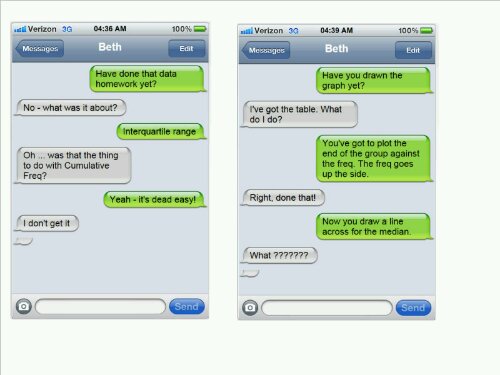
I used it as an ice-breaker for revising cumulative frequency. The class read the texts and discussed what they could remember and whether those pointers were helpful. There were four screens of hints.

In fact the class liked it so much I printed out the fake screens and they stuck them in their books.

Motivation
I’m also using the site to encourage more engagement with homework for lower ability students.

I could have set the homework task ‘Write down key facts that help you work out percentages’. Instead I asked them to ‘Imagine a friend had texted for help with a percentages homework. What would you text back?’

When they hand their work in, we can turn the best advice into fake texts to stick in their books or use in a wall display.

Two of those who have homework ‘issues’ have already said they are going to text each other tonight to do their work. This resulted in the following unusual question:
‘Please Miss, can we hand in our work by showing you our phones?!’
35. Ratio that is good enough to eat

I originally did this activity for a class that I taught twice in a day, but it would work equally well on sequential days.

Equipment
Recipe cards labelled A, B, C, D
Microwave or friendly food tech teacher who will lend you their room
Rice Crispies (or Cornflakes)
Chocolate
Bowls & spoons
Oven glove
Cake cases

Aim
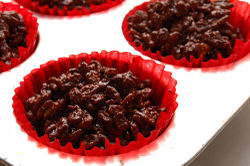
If you haven’t guessed from the equipment list, you are making chocolate rice crispie cakes to investigate ratio.

image

Before you start
You need to have at least 4 different recipe cards. Two of them should have the same ratio of chocolate to cereal, but in different quantities. I had one as double the other. The other two should have common errors eg adding rather than multiplying to increase.

Practical
The messy part.

Make the rice crispie cakes and leave them to set. You should make sure each set of cakes is labelled with the recipe letter.

Discussion
This is the fun part. Taste testing in the second lesson – they will be keen to get started.

Each pupil tries each recipe and comments on how they taste. Depending on your recipes, one should be too dry, one should be too chocolatey* and two should be identical. You can then look at the recipes to explain this by comparing quantities and introducing ratio.

*Some will say you cannot have too much chocolate, but if you use Mars bars the high sugar content means they go rock hard if there is not enough cereal. So hard in fact that two boys decided to eat a whole cake each because no one else wanted them and they were quiet for more than ten minutes!

You’re being watched…
I first did this activity 10 years ago when I knew I was being watched by my Head of Department in the tasting/discussion section. The class were a bouncy low ability Y9 group.

They loved it, my HoD loved it and it’s never let me down as a lesson concept since.

26. FDP Pyramid

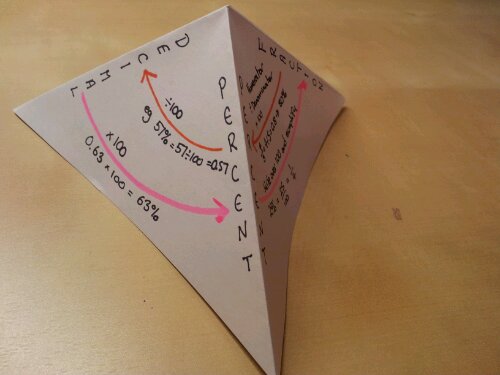
This nifty little pyramid summarises how to convert between fractions, decimals and percentages.

Equipment
A5 paper or lightweight card
Scissors
Pens
Glue/tape
Compasses & pencil

Make a square
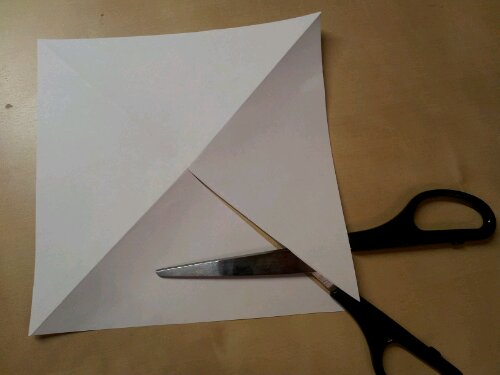
Fold the paper over to make a perfect 45 degree angle. Cut off the excess paper to make a square.

image

Fold & Cut
Unfold the square and fold the opposite diagonal. Cut from one corner to the middle along the fold.

image

Label
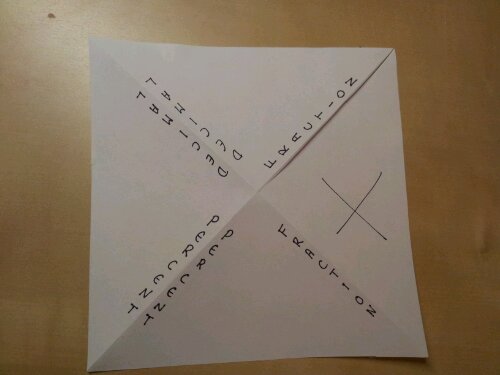
Draw an X on one of the quarters next to the cut. You will glue this piece later.

Either side of each fold label ‘Fraction’, ‘Percent’, ‘Decimal’.

image

Arrows
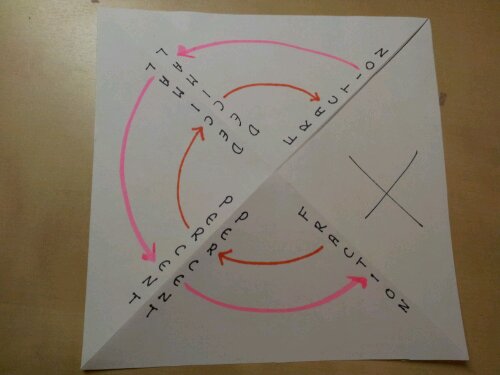
Using compasses and pencil, lightly draw two circles. Go over these lines with a pen to create one set of arrows going clockwise and one set anti-clockwise.

image

Facts
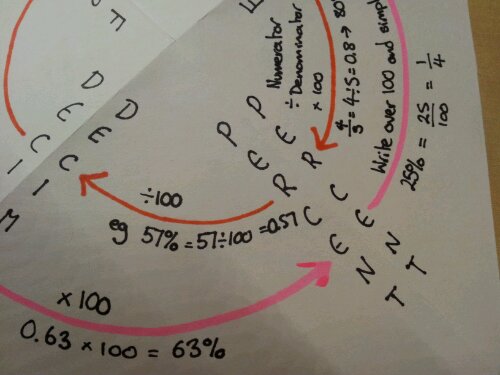
Label each arrow with the correct conversion fact and example.

image

Stick
Fold the X flap behind the next section and glue in place.

image

Summary
This is a tactile activity which could be used on a wall display. It can also be collapsed down flat where it can be taped on one side into a book and ‘pop up’ when required.

19. Fraction Skills Foldable

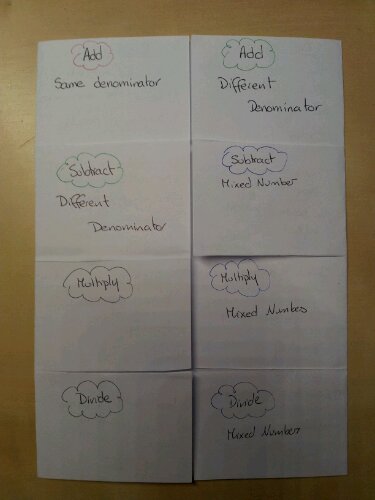
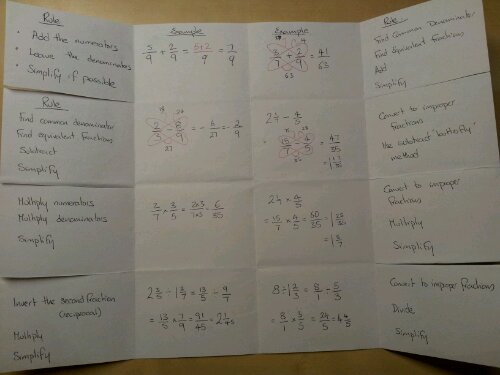
This resource was designed to recap basic fraction skills as part of KS4 revision. The foldable covers:
1. Addition with common denominator
2. Addition with different denominators (butterfly method)
3. Subtraction with different denominators (butterfly method)
4. Subtraction with mixed numbers
5. Multiplication
6. Multiplication with mixed numbers
7. Division (reciprocal method)
8. Division of a whole number by a fraction

It also deals with equivalent fractions, simplifying and converting between mixed & improper fractions.

Each section has a title, method and example.

image

This is a draft ‘teacher’ version. My students made theirs look really good with different colours, highlighter and their own examples.

image

Note: this isn’t for teaching a full understanding of fraction manipulation, just summarising facts.

16. Library Fines (Sequences)

image

County Library
The first day a book is overdue, you are charged 4p. Each day incurs another 4p.
What are the charges for the first week?
(4, 8, 12, 16, 20, 24, 28)
What is the Nth term?
(4N)
How much would you be charged for being 25 days late?
(100p)

Village library
The village library charges 10p for the first day and 3p for every subsequent day.
What are the charges for the first week?
(10, 13, 16, 19, 22, 25, 28)
What is the Nth term?
(3N+7)
What is the charge for 30 days?
(97p)
How many days late is one book if the fine is more than £2?
(Solve 3N+7>200)

Look back at both libraries. Under what conditions do the libraries have the cheapest fines?
(1-6 days: County Library
7 days: same
8+: Village library)

Extension
Why do the libraries have the same charge on the 7th day?
Prove it algebraically.
(Solve 3N+7=4N)

You can also extend this investigation to looking at calendar dates, with one library open 5 days a week and the other being open 6 days with fines only applying when libraries are open. How would this affect the ‘cheapness’ of fines when days are included?

Adaptations
This method can be used for car hire, mobile phone comparisons, energy bills because sequences link so well with graphs of real life problems.