Category Archives: Resource

162. TMNW – Learning wall 2

This post is a progress report on the learning wall from the post 160.

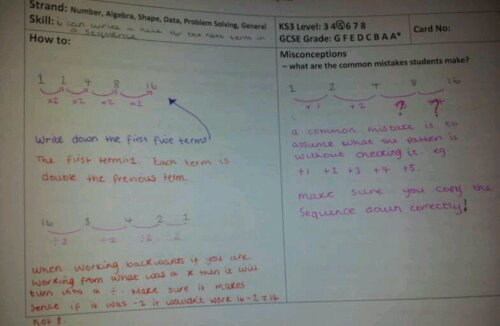
I gave Year 11s (post GCSE group) A4 templates and objectives from the Y7 scheme of work. Their job was to write a clear explanation and address common misconceptions. They were free to use any resource in the room or on the internet to help them.

Here are some examples of their work:

image

image

They would make a great wall display on their own. If you want to use this template you can download it here: Student template.

The next task is to put their explanations onto help cards. The idea is to have the explanation and a question on the front of each card and the misconceptions and worked solution on the back. I will also have the chance to correct any errors before they reach the wall.

So far, so good …

158. May I take your order, sir?

Imagine getting your class to think about a number topic in a real-life context and subsequently having students leave the lesson feeling happy they could use this skill.

About as real as the square root of minus one? Not if you relate it to breakfast*

Image credit: ifood.tv

I wanted to make estimation more relevant for my class, a low ability Year 10. Outside my classroom I put a breakfast menu and my associate teacher took their orders** as they entered the classroom. I had put mini whiteboards on tables and I instructed the class to work out an estimate and the accurate total for their menu choice(s). The lesson had barely begun and the class were already talking about what they were doing (rather than Halloween antics the night before)!

Once everyone had arrived and settled down, I asked if anyone had underestimated and what this would mean – not enough money and doing the washing up!

I then asked each table how much their group order would cost. Would their overestimates cancel out their underestimates? Would the waiter get a tip? Meanwhile the associate teacher had added up the orders, so we could quickly check their calculations.

What if everyone paid £10? Would you have enough? How much tip would you be leaving? Would it cover a 10% service charge?

We followed up this task with some standard estimating questions.

Image credit: www.fudds.ca

The menus I used for the lesson are from a restaurant chain in California. The useful thing is there are no units of currency, so this works for different countries. It will work equally well with KS2 and KS3 pupils.

Download resource: Breakfast estimation (pdf)

BTW The students decided if the waiter wanted a tip, he should actually feed them first!

*Strongly suggest you use this before students have break or lunch time, or else they’ll be drooling in their next lesson.

**Unless you are providing food, please add the disclaimer that you are not feeding them.

156. Tweeting tips

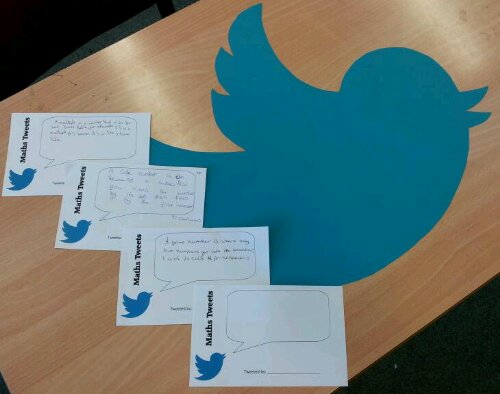
Here’s a quick idea for revising or researching vocabulary: Maths tweets.

image

I know that lots of educators on Twitter like to use tweets to summarise learning. I used this with my Year 7s to investigate the meanings of Prime, Factor, Multiple, Square number and Cube number.

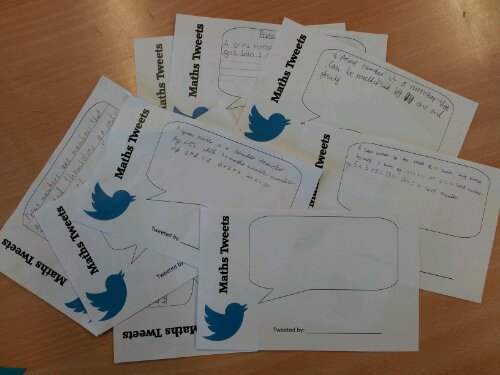
After they independently researched the meanings and wrote the definitions in their books, I challenged them to summarise their learning in 140 characters or less. They then filled in their ‘tweets’.

image

If they had leftover characters they could create their own hashtags.

image

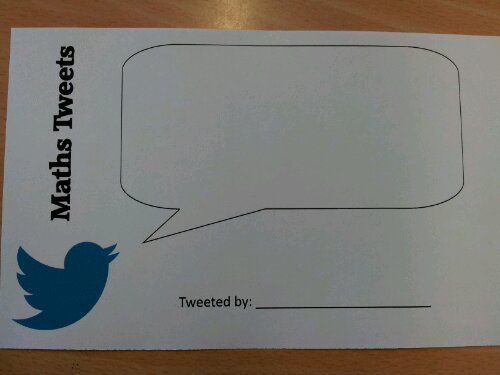
The ‘Maths Tweets’ sheet didn’t take long to put together – you can download the maths tweets template here (pdf format).

155. Trigonometry & Differentiation

image

My Year 13 class have just finished C3 and actually asked a very sensible set of questions:

  • Which formulae are given to you?
  • Which formulae must you learn?
  • Which formulae can you work out from given rules?
  • How do you prove simple rules?

In response to this, I’ve written a booklet for the Edexcel C3 paper: Trigonometry and Differentiation: What you are given and what you need to learn (docx) ( PDF Version)

135. Book (& Website) of the week 2

If you are on Twitter, you may have heard of the perfectly titled @MathsBookClub. If not, let me explain.

People were asked to nominate their favourite Maths related book (Fiction or Fact).

People voted and the most popular was chosen.

The winner was: ‘Alex’s Adventures in Numberland’ (‘Here’s looking at Euclid’ USA) by Alex Bellos.

Just like a “meet down the pub bookclub” there will be an online discussion on Wednesday 23rd October. Except with this bookclub, the author has offered to join in! Very cool!

To join in the mathematical literary fun either follow @MathsBookClub on twitter, visit the mathsbookclub website or do both!

(Support your local Library. If that’s not possible then click on the book for a link to the paper version on Amazon.co.uk; ebook also available)

134. Revising around in Circles

Ah … beloved GCSE students. Why does revising feel like I’m just reteaching a topic for the Nth time?

image

I’ve been trying some new ideas out on my GCSE group. One of the more popular ones ideas, for an unpopular topic, were these Circle Theorems fact cards. Students were given four cards with a diagram and an open question, for example: What is special about angles ABD and ACD? In the gap, they had to answer the question. They soon realised that the answers they had written were the theorems that they’d learnt. Their solutions had popped into their heads, without being bogged down by number stress. They could then try number questions, referring back to these fact cards if they got stuck.

130. Banging your head against a y-axis

Confession time!

I like teaching co-ordinates.

I like teaching plotting graphs.

But …..

Getting pupils to draw axes drives me up the y-axis.


Right now I can sense people shaking their heads – why are you doing co-ordinate plotting if they can’t draw axes?


The problem is that they can draw axes, but for some pupils it takes about half an hour to get lines drawn with a ruler, axes marks equally spaced, lines (not gaps) numbered. For other pupils, their particular SEN means it’s a struggle using equipment. Should I be penalising pupils because they are slow to draw axes, when I know they’ll work brilliantly if I give them axes?


So I’ve put together an A4 sheet of axes. There are two identical sets: the x-axis goes from 0-10, the y-axis goes from 0-18. There is also space to write name and Question number so you can keep track of who has done what. I know there are many websites that will generate these for you on demand, but I’ve just used what was available to me at the time to make something that works for my pupils.


You can download it from TES resources here.