Category Archives: Resource

271. Bored with exponentials

I have a Pi-loving colleague who is a whizz with voting presentations.
love pi

Mr D created these review activities for use with A2/C3 students. The focus is logarithms, exponentials and Ln functions, including models for growth and decay. I particularly like the equation measuring boredness in a Maths lesson. It’s obviously wrong – how could a Maths lesson possibly be boring?

Exponentials and logs review (pptx)

Exponentials and logs review (ppt)

Optional Variation

We paired up this presentation with Qwizdom voting handsets. If you don’t have them, you could try out Socrative and turn students’ mobile phones into voting handsets
270. A whiff of cheese and exponentials

Here is an introduction to modelling exponential growth and decay … using cheese!

Exponential growth and decay (pptx)

Exponential growth and decay intro (ppt)

I used this as a starting point whilst teaching the Edexcel C3 course. You could even demonstrate with fresh and not so fresh cheese. I’m sure the staffroom or sixth form fridge will have some ‘interesting’ examples.

269. Snappy Proportion

Proportion … it comes in so many forms and different students grasp different elements at different speeds. Differentiation hell!

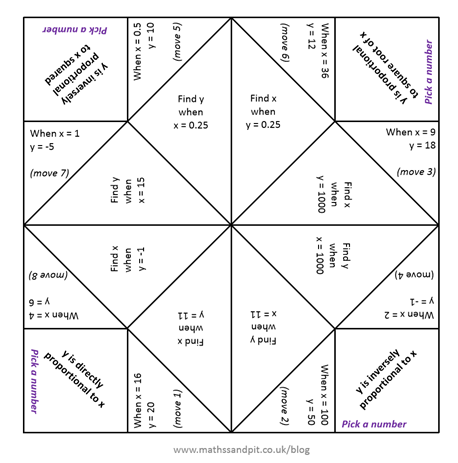
What about a little resource that offers up 4x8x8 variations of question ranging from simple direct to proportion to inversely proportional to the square? It’s not a new app, it’s an old app – a fortune-teller snapdragon:

proportion_snapdragon

Print, cut and fold (see 92. Snapdragon Fun for instructions)

  • The first decision chooses level of difficulty – students pick a number and count through the opening/shutting process.
  • The second gives the information to calculate k (eg y=kx) – the number of open/shut moves is specified.
  • The third asks you to apply your equation to a hidden number.
  • Students increase the level of challenge as they do more questions.

Download the pdf here: Proportion Snapdragon

The editable version is available here: Editable Proportion Snapdragon

You may wish to enlarge the pdf on a photocopier to make it more manageable for bigger hands.

267. A little factorising TLC

Here’s a quick resource for you:

Factorising quadratics (pdf)

This worksheet metaphorically holds students’ hands as they work through factorising quadratics where the co-efficient of x squared is greater than zero. My students liked this sheet as it gave them a starting point, it stopped them putting their hand up for every question and it would be useful for future revision.

265. Book of the term!

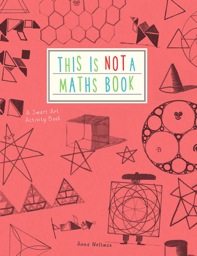
We may only be a few weeks into the summer term, but I can safely say this is my book of the term. A gently inspiring, pick up a pencil and relax book.

image

‘This is not a Maths book’ by Anna Weltman (RRP £9.99) takes all the beautiful ideas we maths teachers wish we could use more often and collects them into a wonderful book.

image

The pages are full colour and the paper quality is excellent – almost tactile. And the best bit is that no-one can tell you off for doing students’ work or wasting your time making that wall display just right. It’s your book … just for you … you can be as possessive and OCD about the colouring pencils as you want!

It would make a good end of term prize too – a bit different to the usual geometry set or calculator. If you are a forward planner, you could even buy this book for your mathematical someone in a departmental ‘Secret Santa’.

263. Percentages Tick or Trash

To quote a famous DIY company from the UK, this post ‘Does exactly what it says on the tin’!

ronsealImage credit: www.ronseal.co.uk

Here is a tick or trash worksheet on percentages, including a couple of tricky ones:

Percentages Tick or Trash inc solution

I usually tick these worksheets until I find a mistake. I then tell the student to have a rethink. Obviously the correct answer is the other option, but the working out will need to be corrected. I also do not tell them how many of the remaining questions are actually correct – they then recheck these before I mark it again.

The only difference with this worksheet is that students have space for working out – no more guessing! The extension task asks students to try and figure out where the wrong (misconception) answers come from – that can be quite tricky and tests their understanding.

262. Percentage Building Blocks

A quick reverse percentages resource for you. I explain reverse percentages by using both calculations and diagrams. These resources can be used as a starter activity or as a selective discussion point. The presentations are editable and the pdf is identical to them. I hope they are useful in addressing the reverse percentages misconceptions!

Reverse Percentage Problem (pdf)

Reverse Percentage Problem (ppt)

Reverse Percentage Problem (pptx)